
Irolin drops: iron food supplement for children with fatigue and iron deficiency anaemia
Iron deficiency in children is a very common condition during the growth phases and may manifest with fatigue, pallor, irritability, difficulty concentrating and reduced energy. In the first years of life, iron requirements increase significantly because this mineral is involved in cognitive development, the formation of red blood cells and the transport of oxygen throughout the body.
An unbalanced diet, periods of rapid growth, increased nutritional requirements or difficulties in intestinal absorption may contribute to the onset of iron deficiency and iron deficiency anaemia in children. In these situations, it may be helpful to supplement iron and micronutrients involved in energy metabolism and physiological development.
Irolin drops is a food supplement based on microemulsified iron, folic acid and copper, formulated to support energy metabolism, the normal formation of red blood cells and the child’s development. Thanks to the liquid drop format, the product is particularly suitable for children and individuals who have difficulty taking solid formulations.
Irolin is indicated in cases of reduced intake or increased iron requirements during growth and development.
Iron deficiency in children: causes, symptoms and the importance of supplementation
Iron is an essential mineral for the growth and correct development of children because it participates in the formation of haemoglobin, the transport of oxygen and the energetic processes of the body. During childhood, iron requirements increase rapidly and, when dietary intake is insufficient, conditions of iron deficiency or iron deficiency anaemia may develop.
The most common causes include rapid growth, iron-poor diet, food selectivity, unbalanced weaning or increased nutritional requirements. Some intestinal conditions may also reduce iron absorption and favour deficiency states.
Symptoms tend to appear gradually and may manifest as:
- fatigue and weakness
- pallor
- irritability
- difficulty concentrating
- reduced attention
- poor school performance
- decreased physical energy
When iron deficiency persists over time, it may also affect cognitive development, energy metabolism and the child’s general wellbeing.
What is Irolin drops and why is it indicated for children
Irolin is a food supplement in drop form formulated with microemulsified iron, folic acid and copper, designed to support the normal intake of iron during growth and development.
The formulation contributes to supporting:
- formation of red blood cells and haemoglobin
- oxygen transport throughout the body
- energy metabolism
- cognitive function
- reduction of fatigue and tiredness
- normal immune function
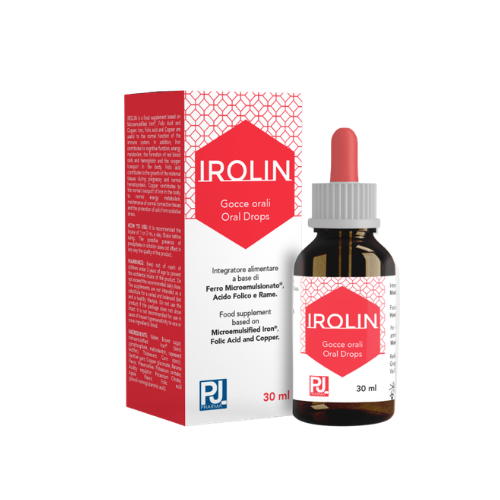
Thanks to the liquid drop format, Irolin is particularly convenient for children and individuals who have difficulty taking tablets or capsules.
One of the distinctive features of the product is the presence of microemulsified iron from ferric pyrophosphate, a technology developed to promote bioavailability and gastrointestinal tolerability. Microemulsified formulations are indeed used in paediatric supplements because they may help improve iron absorption, reduce the metallic taste and facilitate daily intake.
The presence of folic acid and copper completes the formulation by supporting the processes of haematopoiesis, cell growth, energy metabolism and iron transport throughout the body.
During the first years of life, iron also plays an important role in neurological development, cognitive function and energy production. For this reason, an adequate iron intake represents a fundamental element for sustaining the child’s growth, vitality and physiological development.
Scientific evidence on iron and cognitive development in children
The scientific literature has extensively explored the role of iron in cognitive and neurological development during childhood. Iron is indeed a fundamental micronutrient in growth processes because it participates in the production of haemoglobin, oxygen transport and cellular energy metabolism. During the first years of life, an adequate iron intake is particularly important also for the correct development of the nervous system and cognitive functions.
A study published on PubMed has shown how iron deficiency in children can affect attention, learning, memory and cognitive development. The authors highlight that low iron levels during childhood can interfere with certain neurological processes involved in brain development and cognitive function, emphasising the importance of maintaining adequate iron reserves during growth.
Further studies have also explored the role of iron supplementation in paediatric subjects with iron deficiency anaemia and iron depletion. According to the literature, the restoration of adequate iron levels can contribute to improvement in haematological parameters, energy levels and the child’s general wellbeing, especially in cases associated with fatigue, weakness and reduced vitality.
Scientific research has further highlighted the involvement of iron in normal immune function and energy metabolism. Iron indeed contributes to the activity of various cells involved in the immune response and supports the physiological processes related to energy production and oxygen transport in tissues.
These findings therefore support the use of supplements containing iron, folic acid and copper in children with increased nutritional requirements, iron deficiency or conditions associated with fatigue, tiredness and reduced energy during growth and development.
Are you looking for an iron-based food supplement ready for the market or developable as a private label?
We are certified manufacturers of food supplements, medical devices and cosmetics and we develop formulations for growth, energy metabolism and children’s wellbeing. Irolin drops is available for B2B and private label projects with full formulation, regulatory and production support.
Bibliography
- Gingoyon A, Borkhoff CM, Koroshegyi C, Mamak E, Birken CS, Maguire JL, Fehlings D, Macarthur C, Parkin PC. Chronic Iron Deficiency and Cognitive Function in Early Childhood. Pediatrics. 2022 Dec 1;150(6):e2021055926. doi: 10.1542/peds.2021-055926. PMID: 36412051.
- Caballero-Apaza LM, Arbildo-Vega HI, Mamani-Cori V, Padilla-Cáceres TC, Cruzado-Oliva FH, Farje-Gallardo CA, Aguirre-Ipenza R, Vásquez-Rodrigo H, Luján-Valencia SA, Meza-Málaga JM, Castillo-Cornock TB, Coronel-Zubiate FT. Effect of iron supplements on cognitive development in children: an umbrella review. Front Nutr. 2026 Feb 3;13:1718507. doi: 10.3389/fnut.2026.1718507. PMID: 41710280; PMCID: PMC12909201.
- Ward RJ, Crichton RR, Taylor DL, Della Corte L, Srai SK, Dexter DT. Iron and the immune system. J Neural Transm (Vienna). 2011 Mar;118(3):315-28. doi: 10.1007/s00702-010-0479-3. Epub 2010 Sep 29. PMID: 20878427.